
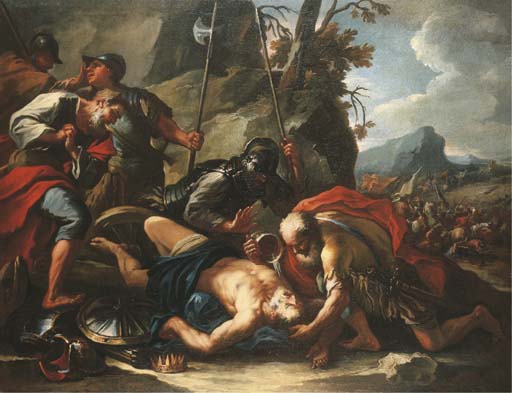
The death of King Josiah at the Battle of Megiddo Painting by Francesco Conti Wikimedia Commons
Josiah's Godly Reign
Josiah became king at the age of eight and ruled in Jerusalem for thirty-one years.
In the eighth year of his reign, while he was still young, he began to seek the God of his father David. In his twelfth year he began to purge Judah and Jerusalem of high places, Asherah poles and idols. Under his direction the altars of the Baals were torn down; he cut to pieces the incense altars that were above them, and smashed the Asherah poles and the idols. These he broke to pieces and scattered over the graves of those who had sacrificed to them. He burned the bones of the priests on their altars, and so he purged Judah and Jerusalem. In the towns of Manasseh, Ephraim and Simeon, as far as Naphtali, and in the ruins around them, he tore down the altars and the Asherah poles and crushed the idols to powder and cut to pieces all the incense altars throughout Israel. Then he went back to Jerusalem. (2 Chronicles 34:3-7)
When he was twenty-six Josiah sent some men to Hilkiah the High Priest to arrange for the repair of the Temple. While they were doing so, Hilkiah discovered The Book of the Law of the LORD that had been given to Moses. Shaphan the secretaray took the book to the king and read from it, Josiah tore his robes as a sign of repentance and gave orders to Hilkiah to inquire of the LORD.
"Go and inquire of the Lord for me and for the remnant in Israel and Judah about what is written in this book that has been found. Great is the Lord's anger that is poured out on us because those who have gone before us have not kept the word of the Lord; they have not acted in accordance with all that is written in this book.”
Hilkiah and those the king had sent with him went to speak to the prophet Huldah. She said to them,
“This is what the Lord, the God of Israel, says: Tell the man who sent you to me, ‘This is what the Lord says: I am going to bring disaster on this place and its people—all the curses written in the book that has been read in the presence of the king of Judah. Because they have forsaken me and burned incense to other gods and aroused my anger by all that their hands have made, my anger will be poured out on this place and will not be quenched.’ Tell the king of Judah, who sent you to inquire of the Lord, ‘This is what the Lord, the God of Israel, says concerning the words you heard: Because your heart was responsive and you humbled yourself before God when you heard what he spoke against this place and its people, and because you humbled yourself before me and tore your robes and wept in my presence, I have heard you, declares the Lord. Now I will gather you to your ancestors, and you will be buried in peace. Your eyes will not see all the disaster I am going to bring on this place and on those who live here.’ " (2 Chronicles 34:23-28)
Josiah's reaction was to call all the people together and to go up to the Temple and read the Book of the Law to the assembled crowd.
He read in their hearing all the words of the Book of the Covenant, which had been found in the temple of the Lord. The king stood by his pillar and renewed the covenant in the presence of the Lord—to follow the Lord and keep his commands, statutes and decrees with all his heart and all his soul, and to obey the words of the covenant written in this book. Then he had everyone in Jerusalem and Benjamin pledge themselves to it; the people of Jerusalem did this in accordance with the covenant of God, the God of their ancestors.
Josiah also removed all the detestable idols from all the territory belonging to the Israelites, and he had all who were present in Israel serve the Lord their God. As long as he lived, they did not fail to follow the Lord, the God of their ancestors. (2 Chronicles 34:23-30)
Then Josiah celebrated the Passover with the sacrifice of thirty-thousand lambs and goats and three thousand head of cattle out of his own possessions. The Levites and priests contributed more and musicians led the worship at the extravagant celebrations.
Josiah's Fatal Mistake
But Josiah made a fatal mistake when King Neco of Egypt went up to Carchemish on the Euphrates to fight. Josiah went out with his army to meet him in battle.
But Necho sent messengers to him, saying, “What quarrel is there, king of Judah, between you and me? It is not you I am attacking at this time, but the house with which I am at war. God has told me to hurry; so stop opposing God, who is with me, or he will destroy you.”
Josiah, however, would not turn away from him, but disguised himself to engage him in battle. He would not listen to what Neco had said at God's command, but went to fight him on the plain of Megiddo.
Archers shot King Josiah, and he told his officers, “Take me away; I am badly wounded.” So they took him out of his chariot, put him in his other chariot and brought him to Jerusalem, where he died. He was buried in the tombs of his ancestors, and all Judah and Jerusalem mourned for him. (2 Chronicles 35:21-24)
It was a sad end to an otheriwse godly reign.